blog
GooshCloud Builds Sovereign DBaaS on ClusterControl and FishOS
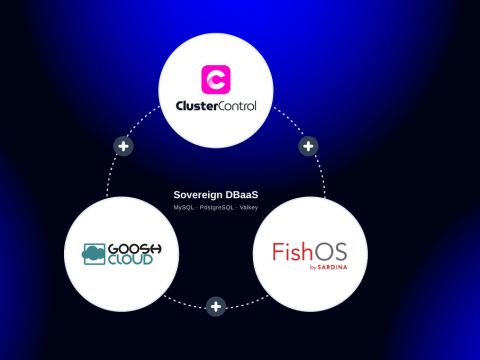
Dutch cloud provider extends its existing Ansible and WHMCS automation with Severalnines’ ClusterControl, running on Sardina Systems’ FishOS, to deliver managed MySQL, PostgreSQL and Valkey from European data centers.
AMSTERDAM and STOCKHOLM, 25 November 2026 — GooshCloud has integrated Severalnines’ ClusterControl into its managed database service on Sardina Systems’ FishOS cloud platform. The Dutch provider now delivers Galera MySQL, PostgreSQL and Valkey clusters from European data centers, with full database lifecycle operations handled by ClusterControl while GooshCloud retains control of the platform, data and customer relationship.
Sovereignty as control, not just location
For GooshCloud’s customers, sovereignty is a question of control rather than geography alone. European hosting settles where data sits. It does not settle who operates the service, whether the databases can be moved, or what happens when a provider changes its commercial terms. GooshCloud’s managed database service is built so the provider runs the platform itself, on open-source database engines its customers can take elsewhere, with an operating model those customers can inspect.
We built our cloud on open-source because portability is a promise you can only keep with technology a customer can take elsewhere. ClusterControl lets us deliver that promise for databases, under our ISO 27001-certified management system, with the operational maturity customers expect from a fully managed European service.
Bas Scholte in 't Hoff, CEO, GooshCloud
European organizations are re-examining what they run and where. Gartner forecasts that European spending on sovereign cloud infrastructure as a service (IaaS) will rise 83 percent in 2026, from $6.9 billion in 2025 to $12.6 billion, identifying governments as the main buyers globally, followed by regulated industries and critical infrastructure organizations.
Regulation points the same way. The EU Data Act has obliged providers to support customer switching since September 2025, and from 12 January 2027 switching charges are prohibited outright. The European Commission’s proposed Cloud and AI Development Act, published in June 2026, would introduce a graded sovereignty assessment into public-sector cloud procurement.
What this changes for providers is the value of portability. A service assembled from open, replaceable components is not merely cheaper to leave, it becomes something to sell. GooshCloud’s customers can see what they are running and move it if they choose, which is the argument the company now takes to buyers who treat their data infrastructure as a competitive advantage rather than as plumbing.
GooshCloud originally ran its database service on an in-house Ansible setup. That approach carried the service through its early years, but as the customer base grew and workloads became more demanding, maintaining bespoke automation across the database layer of a widening estate became the limit on how quickly the service could grow. ClusterControl now takes over the database operations that Ansible previously handled, while Ansible remains in place for server provisioning and WHMCS for service management.
A database operations layer, not a replacement platform
ClusterControl was implemented as a focused database operations layer inside GooshCloud’s existing service platform, rather than as a new platform to migrate onto. GooshCloud’s continuing use of Ansible and WHMCS shaped the requirement: the company needed something lightweight and API-accessible that fit alongside its existing provisioning and service-management workflows.
ClusterControl handles full database lifecycle operations — deployment, monitoring, backup, recovery, failover and scaling — covering the Day 2 work behind a managed database service. The implementation covers Galera-based MySQL, PostgreSQL, and Valkey clusters.
Sovereignty should not mean having to build and maintain every layer of the data stack yourself. That is the trade-off pushing providers towards hyperscaler dependency: either you own everything, or you give up control. GooshCloud has shown there is a third option — keep the platform and the customer relationship, and bring in specialized automation for the layer where it earns its place.
Vinay Joosery, CEO and co-founder, Severalnines
Three layers, open at the core, all under the provider’s control
GooshCloud operates an OpenStack-based cloud managed with FishOS across Europe, with teams in the Netherlands and Portugal. FishOS, a cloud management platform by Sardina Systems, provides the cloud foundation for GooshCloud. ClusterControl provides the database automation. GooshCloud operates the service for its customers.
OpenStack and open-source database engines provide the foundation for the service, supporting portability as GooshCloud’s platform evolves. A customer can take its databases elsewhere; GooshCloud can evolve its platform without renegotiating with a hyperscaler.
GooshCloud operates its platform under an ISO 27001-certified information security management system, with GDPR compliance and NIS2 readiness forming part of its security and governance approach.
European providers need two things at once: control over their infrastructure and data, and operations that stay predictable as the business grows. An open-source foundation gives them the first. FishOS delivers the second, automating the operations, monitoring, and upgrades of the cloud, just as ClusterControl does for databases. We expect more European providers to follow GooshCloud on this practical path to sovereign infrastructure.
Kenneth Tan, Executive Director, Sardina Systems
Availability
GooshCloud’s managed database services are available now from its European regions at https://www.gooshcloud.com/managed-databases.