
DATABASE FLEET MANAGEMENT
Standardize database operations. Keep control of your infrastructure.
Bring deployment, monitoring, backup, recovery and lifecycle operations into a consistent operating model across your database estate. ClusterControl helps experienced teams operate supported databases on infrastructure they control—without making a move to one cloud or one database engine the starting requirement.
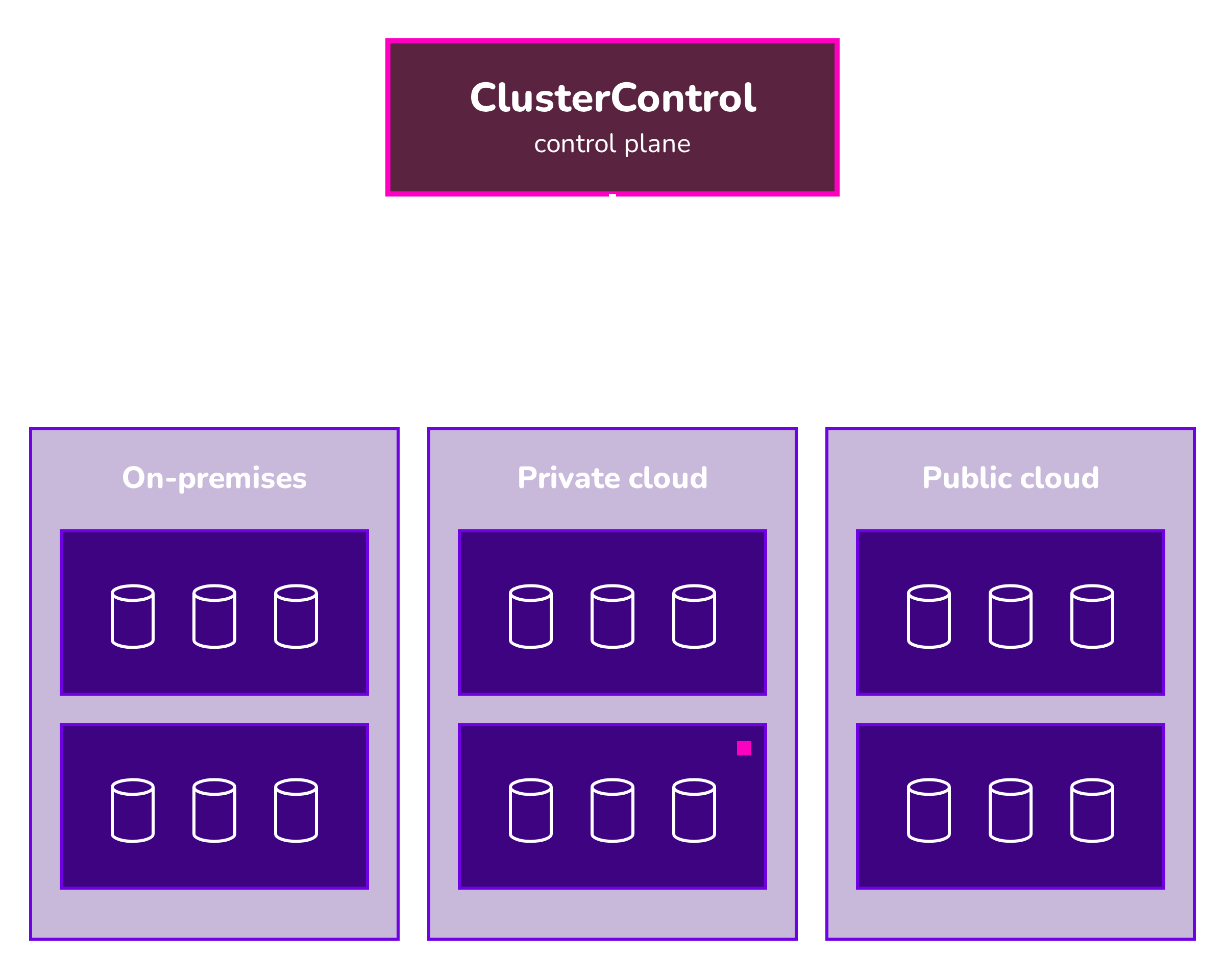
More databases should not mean more disconnected operating practices.
Different engines, environments and owners can leave teams with inconsistent backup policies, fragmented visibility and change procedures that depend on individual knowledge. The task is not simply to see the estate. It is to know what needs attention, who owns it and which action is appropriate.

Consistent operations
Standardize supported lifecycle workflows while preserving the exceptions your services need.

Recovery you can verify
Connect backup work to restore validation and application acceptance.

Controlled change
Use reviewable workflows, clear responsibilities and bounded evaluation before extending automation.

A large-estate example, with the operating model made explicit.
ABSA’s published case study describes using ClusterControl across an estate of more than 3,000 database nodes and as part of an internally built database service. The example shows how database automation can support a broader operating model while the organization retains responsibility for its service layer.
Manage the lifecycle, not just the next alert.

Bring existing databases into scope
Assess supported import and management paths without assuming every cluster can be imported unchanged.

Operate with a consistent view
Monitor supported environments and connect observations to accountable actions.

Back up and validate recovery
Automate supported backup/restore workflows and verify the result against the workload’s requirements.

Integrate operational work
Use supported APIs, CLI and operator/GitOps workflows where appropriate to the deployment.
A consistent operating model across different environments.
Retain the database and infrastructure choices that fit your workloads. Define the management topology, access paths and operational responsibilities around your environments, then validate supported workflows within those boundaries.
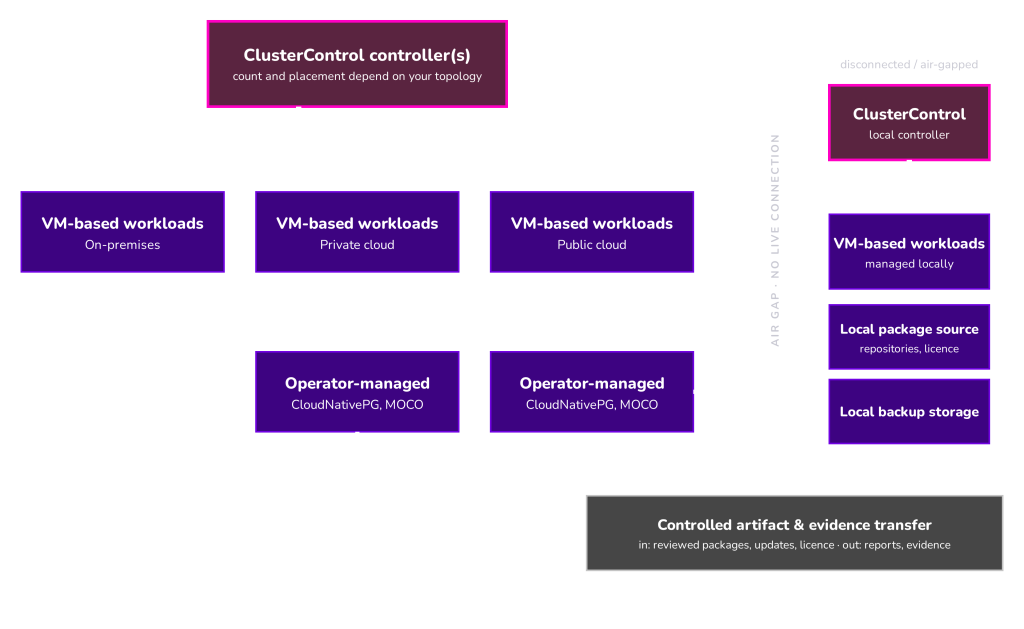
Operate where connectivity is constrained.
Restricted networks change how software is delivered, dependencies are reached and operational evidence is collected. Plan the supported offline installation path alongside local package sources, licensing, backup storage and maintenance procedures. Validate the required lifecycle operations for the specific engine, version and network profile.
N.B. Restricted egress, private connectivity and a genuinely disconnected environment are different requirements. An architecture review should make the distinction explicit.

Restricted egress

Private connectivity

Disconnected (air-gapped)
Confirm coverage for your engines and deployment modes.
Use the supported-database matrix to check the engines, versions and operating modes in your estate. Then validate the operations that matter to each workload — rather than assuming a supported engine means identical functionality everywhere.





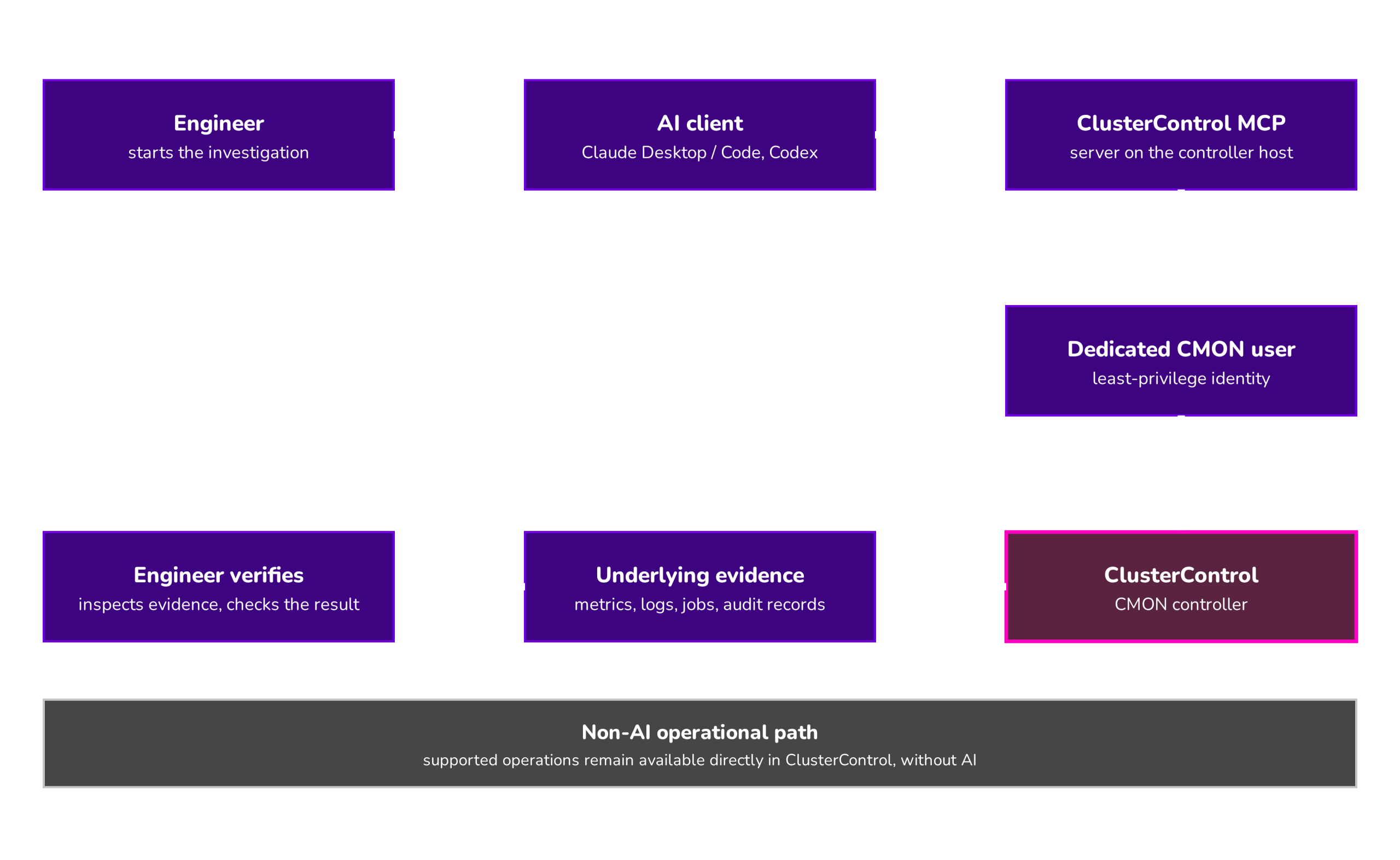
Investigate with evidence. Act within defined permissions.
Bring AI-assisted investigation into the operating workflow where it is supported and appropriate. Use ClusterControl MCP with an explicitly scoped executing identity, inspect the underlying evidence, and verify the result of any authorized action. Keep a non-AI operational path available.
Operating an estate or delivering a database service?
ClusterControl
Your team owns database operations and needs consistent automation and control across its estate.
CCX
Your goal is to provide managed database services to internal developers or customers.
Start with a bounded operational problem.

Map the estate
Engines, environments, network profiles, owners and critical workflows.
Validate representative operations
Select a supported deployment, recovery or maintenance exercise and agree acceptance criteria.
Extend deliberately
Add coverage by workload/domain while retaining clear ownership, exceptions and evidence.
Make the next step specific to your estate.
Bring the shape of your estate, the workflows that consume the most attention and the constraints you cannot change. A fleet assessment starts by mapping supported fit, operational gaps and a practical evaluation scope.
 Supported fit
Operational gaps
A practical evaluation scope
Can we bring existing databases into the operating model?
Assess the supported import and management paths for your engine, version and deployment. Existing workloads do not need to be treated as a migration project by default, but the correct path and prerequisites must be checked for the actual estate.
Does fleet management require thousands of databases?
No arbitrary count defines the need. Multiple engines, environments, teams or operational requirements can create meaningful complexity even in a smaller estate. State whether you are counting nodes, clusters or services when discussing scale.
Can ClusterControl support restricted or air-gapped environments?
ClusterControl documents offline installation and deployment workflows. The full operating requirement also includes local software sources, licensing, backups, maintenance and optional integrations. Validate those dependencies for the chosen configuration rather than treating offline installation as universal lifecycle parity.
Do all supported engines have the same operational capabilities?
No uniform capability matrix should be assumed. Check the authoritative documentation for the engine, version, topology and deployment mode, and test the workflows important to your service.
Do we need AI to operate the estate?
AI assistance is an optional supporting workflow, not a prerequisite for the core operating model. Its permissions, data flow and network dependencies should be assessed separately.
When should we consider CCX instead?
Consider CCX when the primary job is delivering database services to developers or customers. ClusterControl is the estate-operations route and can also support teams that deliberately build and own their own service layer.