
Current supported databases



Connect Your Database and Start Fixing Now
Benefit from over a decade of PostgreSQL, MySQL, and MariaDB operational expertise. Simply connect DBScout to your database servers to immediately stream performance signals, leveraging AI for DBA-grade insights and permission-based interventions.
Connect in Minutes: Link your database servers to securely harvest performance signals.
Receive Prioritized Findings: DBscout delivers severity-ranked issues, eliminating alert fatigue.
Guardrailed Automated Remediation: Read-only by default, you define the exact boundaries and decide which database issues it is authorized to resolve autonomously.
How DBscout Works
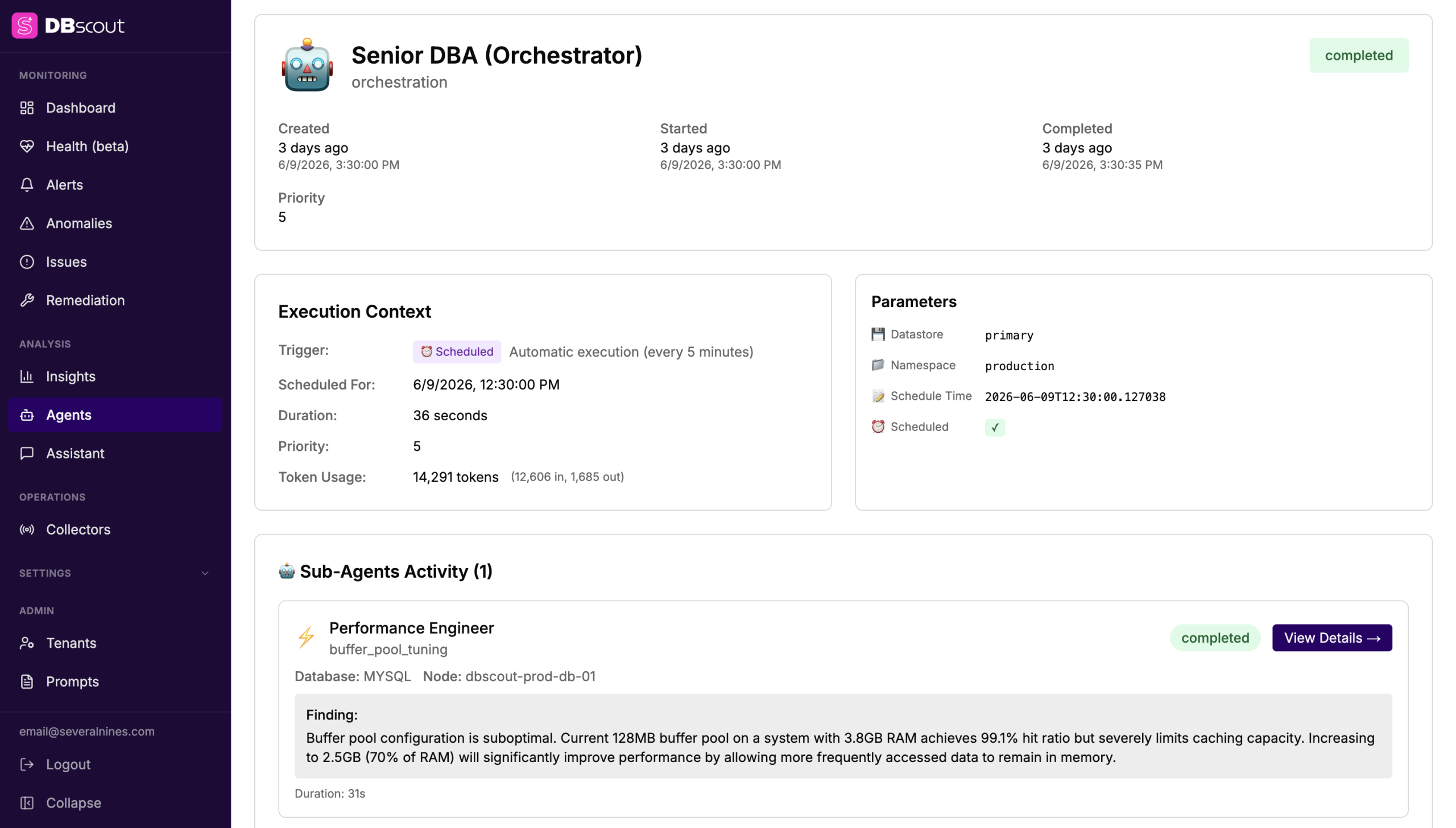
Our agents continuously scan your databases
Local agents capture metadata, configuration files, and performance signals from your database servers up to every hour to spot immediate anomalies.
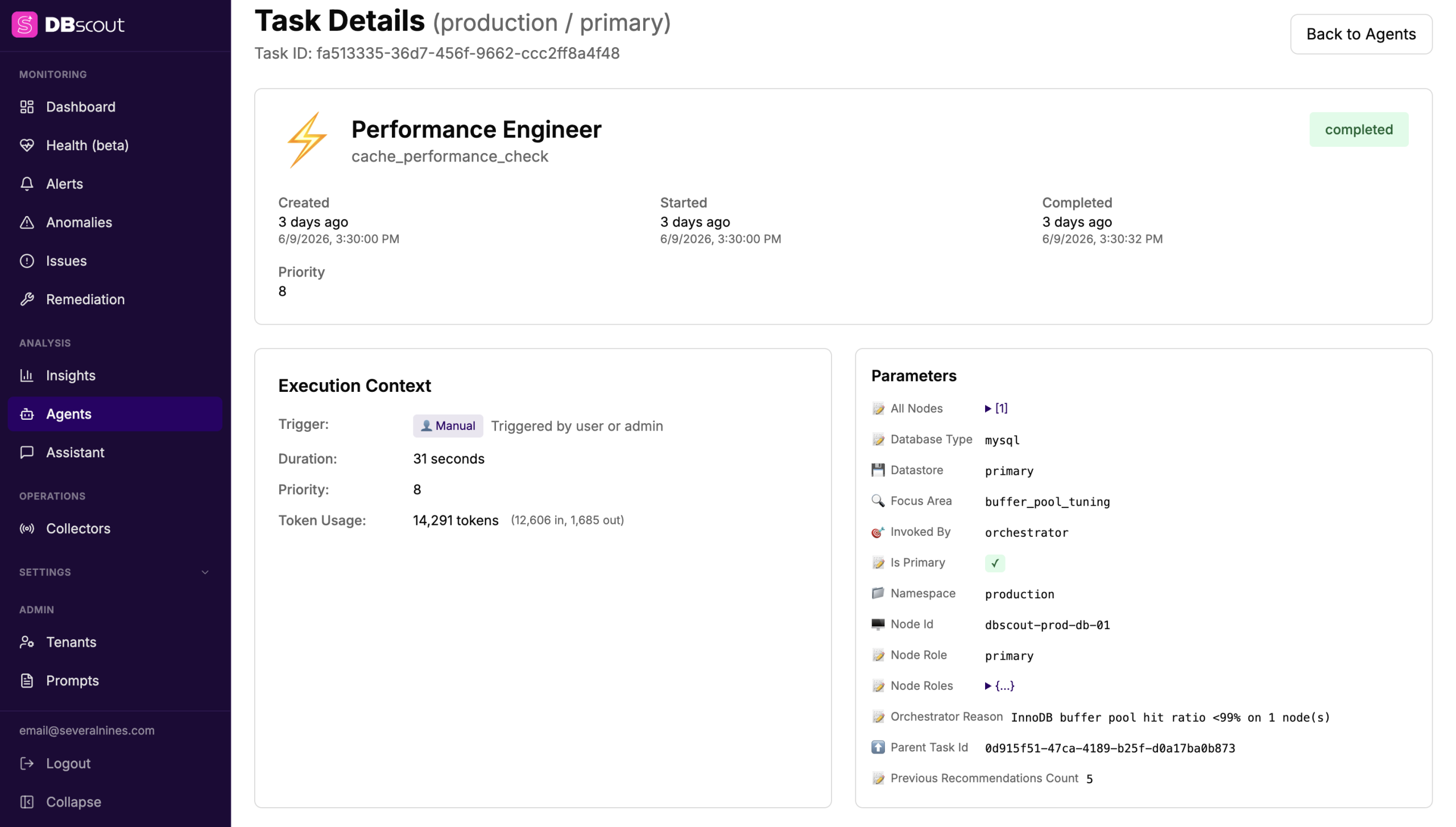
Specialized agents run deeper analysis
When a baseline scan flags a potential issue, specialized agents trigger a deep dive, e.g. a SysAdmin agent analyzing compute resources if a server is redlining.
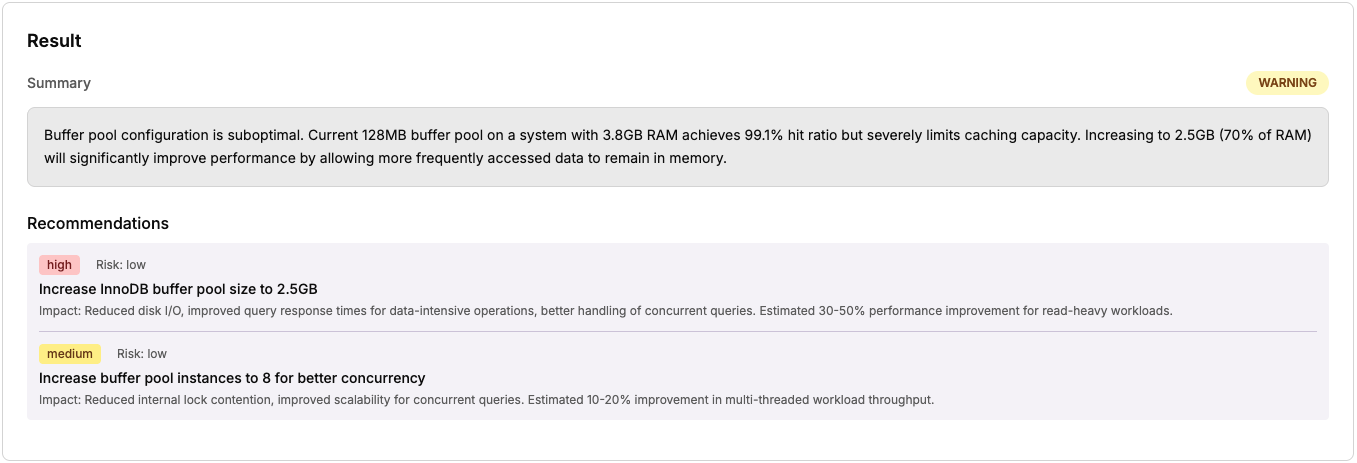
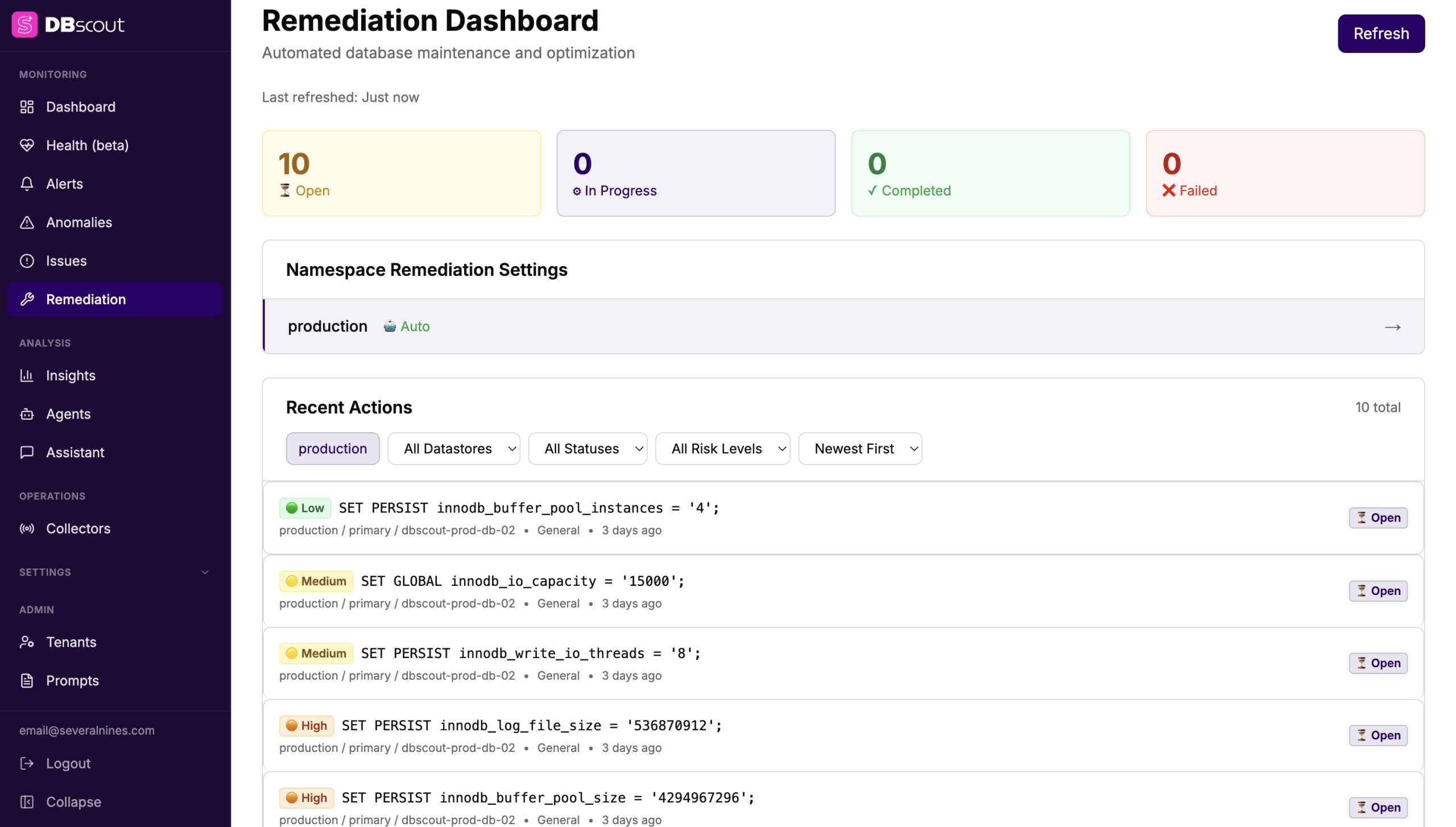
DBscout resolves issues on your terms
Actionable fixes are logged into a central queue for manual approval and change management. Alternatively, you can authorize guardrailed auto-fixes based on database server issue severity.
DBscout’s Core Agents

The Senior DBA Lead
DBscout’s lead operator. The Lead runs scheduled scans, triages findings, and decides what warrants deeper analysis. When needed, it routes cases to specialist agents, then synthesizes their outputs into a single, approval-ready remediation Pack. It focuses on clarity and trust: each Pack includes evidence, risk level, expected impact, safe steps, and rollback notes so teams can approve changes confidently and maintain an auditable record of decisions.

The Performance Specialist
Specializes in performance diagnosis and optimization. The Performance Engineer correlates workload symptoms with system constraints and database behavior to identify bottlenecks and likely root causes, e.g. contention, slow queries, I/O saturation, cache pressure, inefficient configurations. It produces evidence-backed recommendations with clear tradeoffs, expected gains, and rollback guidance, helping teams improve latency and throughput without guesswork.

The Security & Compliance Guardian
Focuses on security posture and auditability. The Security Auditor checks for common hardening gaps, risky configurations, and platform/engine concerns (including version/EOL and vulnerability-relevant signals where available). It prioritizes issues by severity and exposure, then produces remediation proposals detailing risk, evidence, validation steps, and rollback. This makes it easier to operationalize security work instead of relying on manual checklists.

The Capacity Architect
Helps teams stay ahead of resource growth and saturation. The Capacity Planner analyzes trends and headroom, e.g. storage growth, CPU/memory pressure, I/O patterns, to identify when capacity constraints are likely to become user-visible. It recommends scaling and tuning actions with practical thresholds, timelines, and risk considerations. The goal is to reduce capacity-driven incidents, giving lean teams clear, evidence-backed plans before system failure.
DBscout is Not Just O11y, It’s More
Dashboards only tell you that something is wrong. DBscout tells you exactly what to do through a comprehensive proposal or fix the issue for you depending on permissioning.

Evidence
Clear pointers to the logs, metrics, and configurations that triggered the finding.

Risk Rating
An honest assessment of the potential impact on your production environment.

Rollback Steps
Practical steps to revert changes if the environment doesn’t respond as expected.

Red Flag Detector
Candid advice on when to stay the course instead of intervening.
Key DBscout Concepts
Choose the Plan That Fits Your Needs
Starter
Ideal for single teams and early adopters
- 5 million tokens per database server
- Scans up to every 6 hours
- 7 day retention
- Team management
- RBAC
$29 per Month /
Database Server
Growth
Built for small platform teams with multiple databases.
- 10 million tokens per database server
- Scans up to every 2 hours
- 14 day retention
- Team management
- RBAC
$49 per Month /
Database Server
Business
The choice for larger teams with demanding needs.
- 20 million tokens per database server
- Scans up to every 1 hour
- 90 day retention
- Team management
- RBAC
$149 per Month / Database Server
DBscout Agent Plan Availability
| AGENT | Starter | Growth | Business |
| Chat Agent |  | | |
| DBA Lead Agent | | | |
| Sysadmin Agent | | | |
| Performance Agent | | | |
| Query Plan Agent | | | |
| Security Agent | — | | |
| Backup Agent | — | | |
| Workload Profiler Agent | — | | |
| Capacity Planning Agent | — | — | |
Will my sensitive database records or PII (Personally Identifiable Information) be sent to your AI models?
No. DBscout is built on a privacy-first architecture. Our collectors are designed to gather metadata, configuration settings, and performance signals — not the actual data stored inside your tables. Furthermore, all signals are masked locally by the collector before being transmitted to our SaaS environment. This ensures that while our agents understand your database’s behavior and structure, they never see your actual customer data or sensitive records.
How does the “Analysis” credit system work compared to the “Regular Scans”?
Think of Scans as your automated, 24/7 background surveillance; they run on a set schedule (e.g., every 6 hours) to find common issues and surface “Findings.” An Analysis is a deeper, LLM-intensive “deep dive” triggered by a user or the DBA Lead Agent to solve a specific problem — like diagnosing a performance spike or analyzing a complex query plan. Each plan comes with a monthly token allowance.
Does DBscout require me to install ClusterControl or use Severalnines as my database hosting provider?
No. DBscout is a standalone, vendor-neutral SaaS product. It is designed to work with your existing database environment, whether it’s self-managed or you are a ClusterControl users. While it offers a natural upgrade path to our automation platforms, no other Severalnines software is required to use the platform.
Can DBscout make unauthorized changes to my production database servers?
No. DBscout operates on a strict “read-only” basis by default. You retain full control and can choose to elevate permissions to enable guardrailed auto-remediation based on issue severity. Otherwise, all findings are delivered as actionable insights for your team to review, approve, and export to your own ticketing or orchestration systems.
What does Public Preview mean for DBscout?
Public Preview means the core platform capabilities and features are live and ready for testing in real-world environments. Although we’ll continuously be sanding down some rough edges and making enhancement, we’re providing access now to give our users practical value from AI while they help us shape our product roadmap. Feedback received during this phase is prioritized by our engineering team.