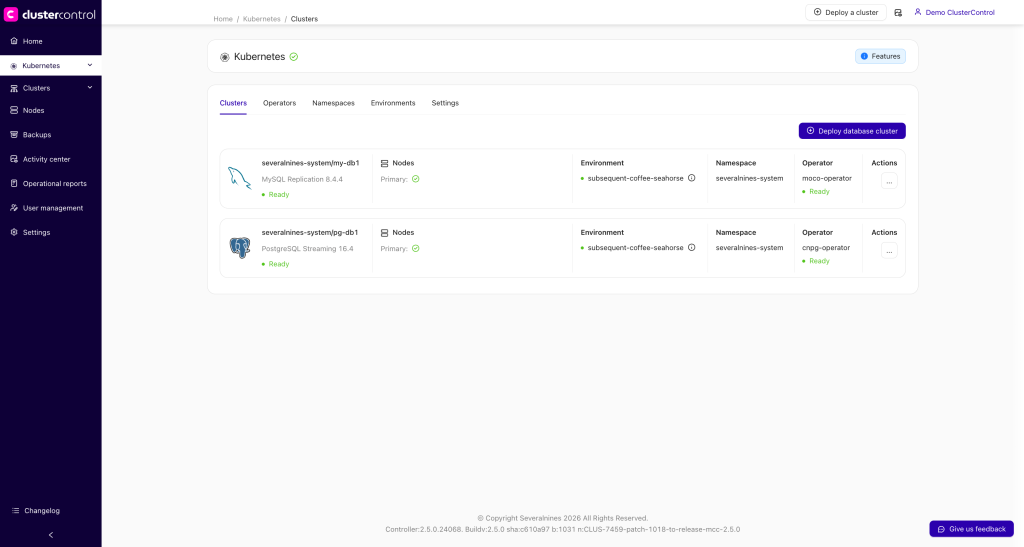
Kubernetes Database Operations Panel

Deploy and manage cloudnative‑pg and MOCO operators, and run MySQL and PostgreSQL database operations through your GitOps workflow from the same ClusterControl UI you know and trust for your VM-based clusters.

What you can do today (GA)

Kubernetes environment onboarding:
Connect a cluster with the ClusterControl agentcheck
Quickly install Argo CD or connect to an existing instancecheck
Operator lifecycle management:
Deploy and manage MOCO (MySQL)check
Deploy and manage cloudnative‑pg (Postgres)check
Customize operator settings via UI or YAML editingcheck
Database cluster operations:
Deploy MySQL and PostgreSQL clusters (from CC UI)check
Manage configuration and resources using templatescheck
Backup orchestration, retention policies, S3-compatible storage supportcheck
Security and troubleshooting:
Credential management, TLS encryption, log retrievalcheck
See all Features
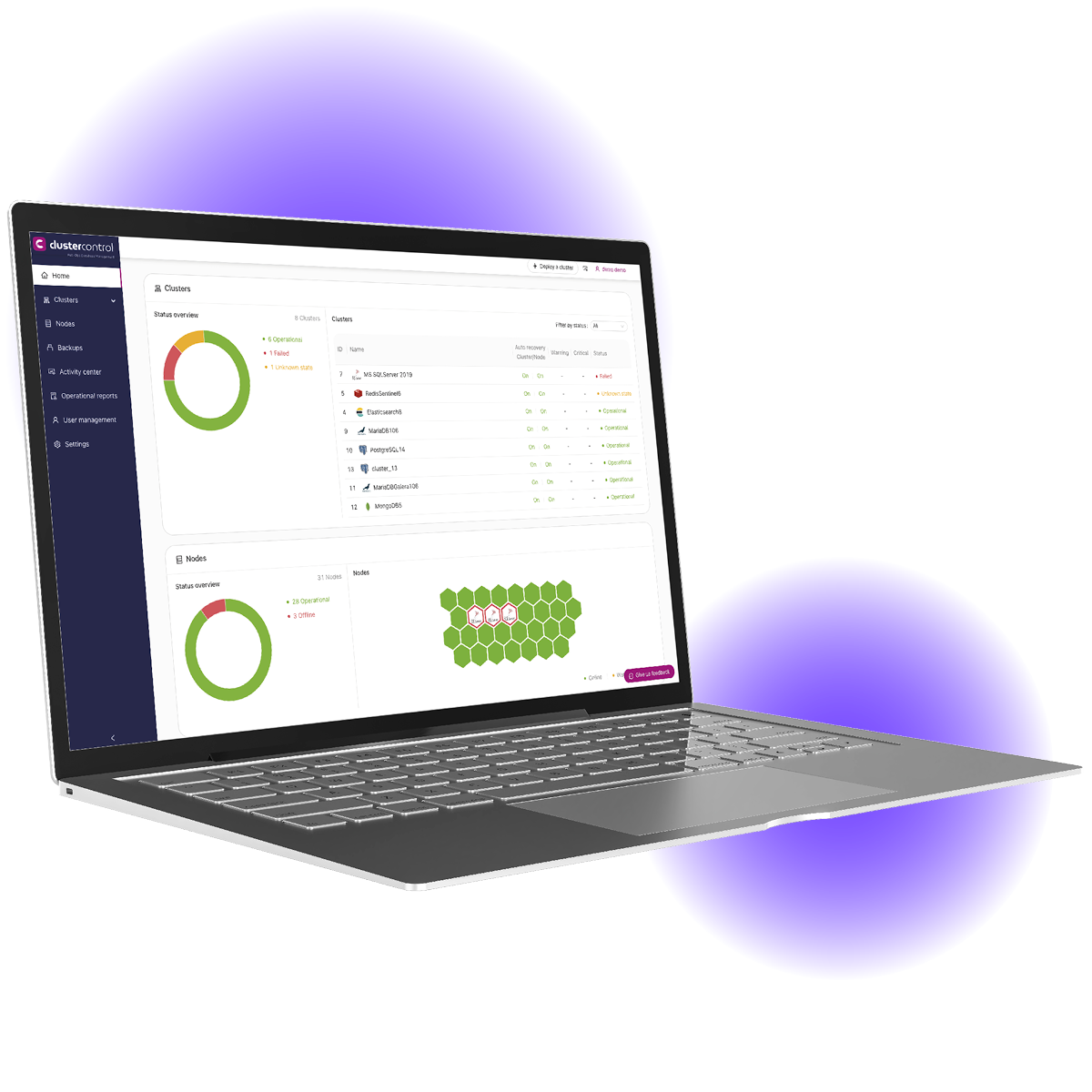
ClusterControl on Laptop

Operator-managed databases shouldn’t mean fragmented ops

Kubernetes operators are great at deployment primitives, but day-2 ops still need a consistent operational layer: visibility, backups, tuning, governance, and an audit trail:

  • One control plane for VM- and Kubernetes-based database operations
  • Integrates with GitOps workflows for repeatable, reviewable changes
  • Faster onboarding to new environments without reinventing tooling

ClusterControl, K8s and GitOps: from intent → running operator resources

Fold ClusterControl into your GitOps pipeline

Step 1: Connect Kubernetes

  • Action: Install the ClusterControl (CC) agent and register your cluster.
  • Output: Kubernetes environment added

Step 2: Connect GitHub repo

  • Action: Choose a repo to store the desired state CC will generate.
  • Output: Manifests committed to Git

Step 3: Connect Argo CD

  • Action: Use your existing Argo instance, or install one during onboarding.
  • Output: Argo application created

Step 4: Deploy an operator

  • Action: Deploy and manage cloudnative‑pg or MOCO from the CC UI.
  • Output: Operator running and managed.

Run your pipeline from one control plane
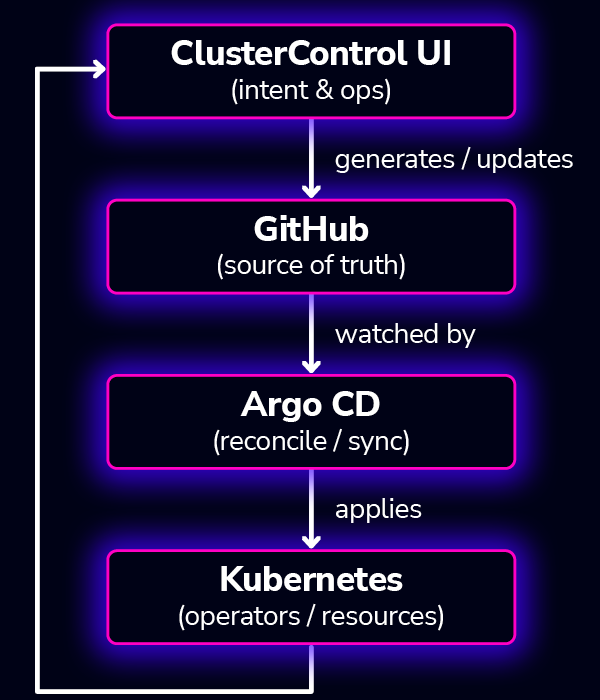
Git is your source of truth, Argo your reconciliation engine, and ClusterControl your workflow interface and operations layer.

Connect Kubernetes to ClusterControl

Learn how to integrate your Kubernetes environment with ClusterControl using a GitOps workflow. This clip covers:

Final Sync: Merging the automated Pull Request to reach “Ready” status.

Environment Setup: Configuring names, ports, and namespaces.

GitOps Integration: Connecting to GitHub via Personal Access Token.

Cluster Deployment: Installing Argo CD and agent manifests using kubectl.

Creating a Kubernetes namespace

This clip demonstrates adding a new namespace to your cluster via ClusterControl while maintaining a GitOps workflow.

PR & Propagation: Walking through the automated GitHub Pull Request and merging it to sync the namespace to the cluster.

Namespace Configuration: Defining the namespace name and environment in the UI.

YAML Preview: Reviewing the auto-generated YAML manifest for the namespace and role bindings.

Deploy Kubernetes Operators

This clip covers the deployment of the CNPG (PostgreSQL) and MOCO (MySQL) operators via a GitOps workflow.

Final Deployment: Merging Pull Requests and verifying the “Ready” status in the cluster.

Configuration & Customization: Selecting the environment, namespace, and version while modifying operator parameters in form or YAML formats.

GitOps & Dependency Management: Tracking automated GitHub Pull Requests for each operator, including the Cert-manager dependency for MOCO.

Deploy Kubernetes Databases

This clip covers the deployment of a three-node PostgreSQL cluster using the previously installed operator.

Validation & Access: Reviewing the auto-generated YAML manifest before deployment, followed by an overview of the cluster details, endpoints, and credentials.

Cluster Configuration: Selecting the environment, namespace, and number of nodes while applying pre-configured database and resource templates.

Network & Storage: Defining storage classes and external access via node ports or load balancers.

Schedule Kubernetes Backups

This clip demonstrates how to configure automated backups for Kubernetes database clusters using S3-compatible storage.

Scheduling & Sync: Setting the backup frequency (CRON format) and reviewing the auto-generated YAML manifest to finalize the automated schedule.

Credential Management: Importing or creating S3 credentials within the ClusterControl interface to enable secure storage access.

Backup Configuration: Defining the target bucket, storage location, and specific retention policies for the database backups.

Manage Configuration Templates

This clip demonstrates how to standardize cluster and database deployments using custom templates.

Template Customization: Adding or adjusting any custom parameter to meet specific infrastructure needs before deployment.

Resource Templates: Modifying or creating templates to define CPU and memory limits, as well as persistent storage volume sizes.

Database Config Templates: Customizing specific parameters for MOCO (MySQL) and CNPG (PostgreSQL) operators to ensure consistent cluster performance.

Review Kubernetes Logs

This clip demonstrates how to access and analyze logs for your database deployments.

Time Range Selection: Narrowing the log view based on a custom time range for precise troubleshooting.

Log Access: Navigating to the logs for specific MySQL or PostgreSQL deployments within the ClusterControl UI.

Advanced Filtering: Searching through logs by specific instance or container to isolate events.

Severalnines is Enterprise Ready

Reliable

Zero-downtime operations you can count on.

Secure

Data stays protected, at rest and in transit.

Compliant

GDPR, SOC 2, ISO27001 standards.

Orchestrate your VM and Kubernetes databases together with ClusterControl

Choose the CC plan that fits your use case and preferred payment terms

Community

  • Deploy and monitor
  • Performance advisors
  • Community support

Check out the feature list

Free

Advanced
self-serve

Includes all features from Advanced

  • Deploy 2 to 5 node clusters
  • Monthly subscription
  • Pay with Credit Card
  • Community support

Check out the feature list

starts at€250per node, per month

€0.35per node, per hour

Advanced

Includes everything from Community

  • Load balancers
  • Scaling and failover
  • Backup and recovery
  • Monitoring and alerting
  • Database user management
  • Business hours support

Check out the feature list

Custom pricing

Enterprise

Includes everything from Advanced

  • CC Ops Centre
  • Backup verification
  • Ops reports and audit logs
  • RBAC & LDAP / Active Directory
  • Key management, TLS encryption
  • Web / email / phone 24×7 support

Compare full feature list

Custom pricing

Kubernetes resources

May 21, 2024

ClusterControl now easily deployable in Kubernetes with our Helm Chart

We’re pleased to announce that ClusterControl (CC) now integrates with Kubernetes environments via our newly introduced Helm Chart. Packaging ClusterControl into a singular Helm Chart simplifies deployment with just a few commands. For DevOps teams…

September 3, 2024

An overview of running your databases on and with Kubernetes

While Kubernetes (K8s) was originally designed for stateless workloads, advancements over the years, including enhanced support for Persistent Volumes, StatefulSets, and Operators, have made it possible to run stateful applications on Kubernetes.  These new features…

November 21, 2024

Kubernetes on-premises: the why, what and how to implement

The siren song of the cloud is undeniable, promising scalability, resilience, and reduced operational overhead. However, the reality can be different. Factors like vendor lock-in, limited control, and unexpected costs, mean that organizations can still…

Is this GA or beta?

This feature is now GA and ready for production environments.

Do I need to already have Argo CD?

No, you can either install it or connect to your existing instance.

What operators do you currently support?

cloudnative-pg for PostgreSQL and MOCO for MySQL.

Is database cluster deployment GitOps-supported?

Not yet. Today, ClusterControl manages the agent connection and operator lifecycle via GitOps (GitHub + Argo CD). GitOps-based cluster bootstrap from Git is planned.

How can I install ClusterControl inside my Kubernetes cluster?

Ready to take control of your data stack?