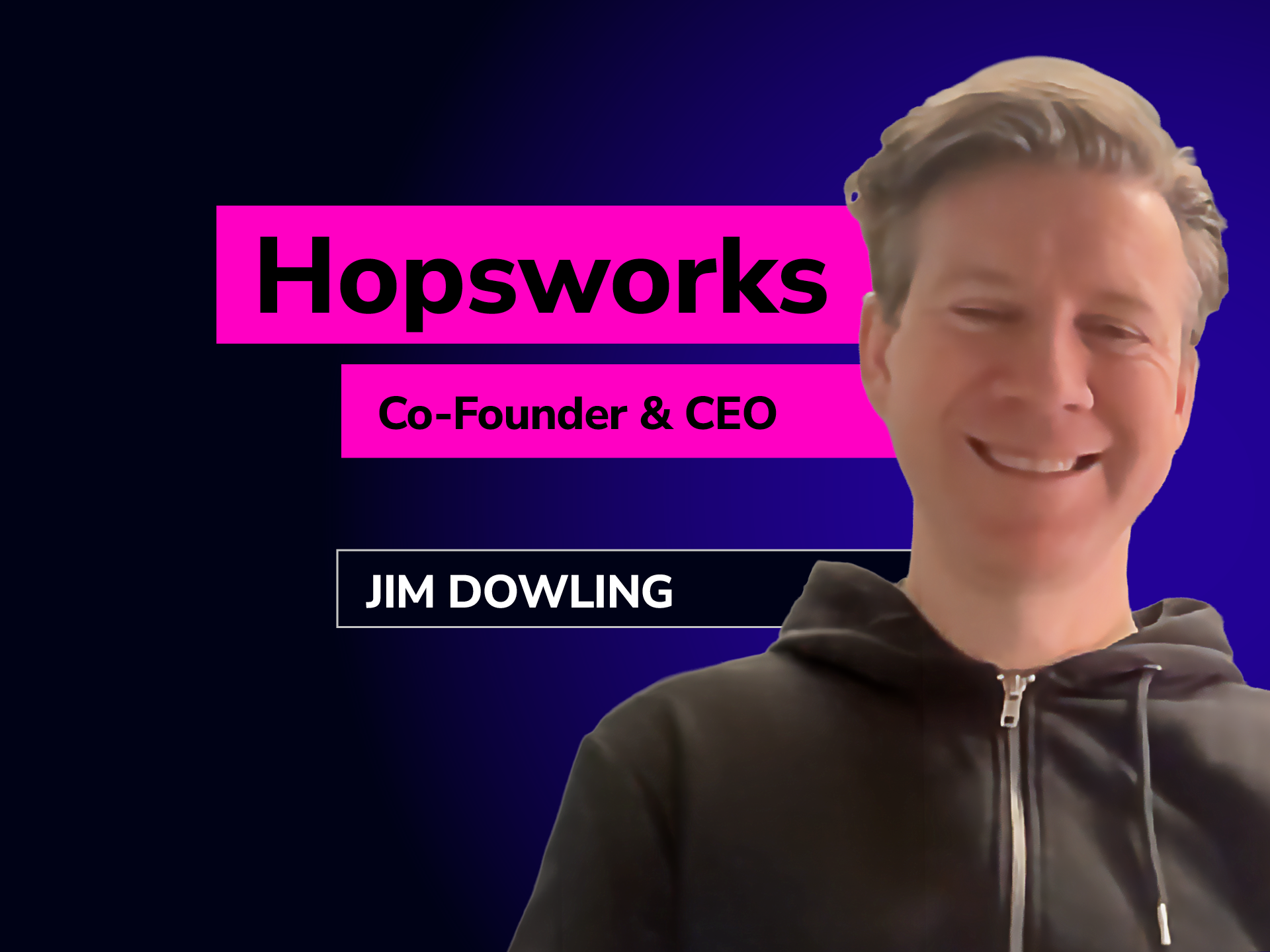
Sovereign AI: Separating brass tacks from talk


In this second episode of 2026…
Vinay Joosery is joined by Jim Dowling, Co-Founder and CEO of Hopsworks, former Associate Professor at KTH, to dissect the operational realities of Sovereign AI. Moving beyond the hype, they explore sovereignty’s technical dependencies — from the “sovereignty washing” of major hyperscalers to mapping out the architecture of a truly independent data stack. The conversation covers the shifting economics of repatriating workloads to European providers, what the most powerful AI system is today, the critical role of databases as the “memory” for LLMs, and a future where agentic programming turns every profession into a software-builder. Jim also highlights how the “software moat” is evaporating in an era where AI can debug, port, and build infrastructure autonomously.
Key insights
AI is broader than LLMs, but they will increase the speed of Enterprise AI adoption
LLMs may be the latest expression of AI, but classical machine and deep learning-based models have their place too. However, LLMs will be unparalleled in unlocking enterprise AI adoption due to their flexibility and accessibility.
AI is amnesiac, databases the memory and agents the messengers
LLMs do not have memory in the operational sense, demonstrating the criticality of data infrastructure. Agents are key to retrieving the right context from databases and other systems to ensure AI-based systems are more accurate and consistent.
Data gravity will make or break Sovereign AI strategy
If data is subject to non-sovereign environments, moving only the model or inference layer to a sovereign location doesn’t really matter. That is why Sovereign AI cannot be treated as a standalone layer detached from storage, processing, and operational databases.
Episode highlights
What sovereign AI actually means [02:20 — 03:25]
Jim explains that sovereignty has both a technical and a governance dimension. Much of today’s software was built around hyperscaler assumptions, making it hard to call a platform sovereign if it still depends on infrastructure and legal frameworks outside your control.
AI encompasses all systems of prediction, [04:05 — 08:35]
The episode grounds AI in a simple definition: systems trained on data that make predictions. LLMs predict tokens, but recommendation engines, fraud systems, and real-time classifiers are also AI. This section is useful because it widens the frame beyond the current LLM hype cycle.
Breaking down the AI stack from hardware to data layer [15:05 — 19:40]
A practical walkthrough of the AI stack: GPUs and accelerators at the bottom, software layers like CUDA, then training and serving frameworks, orchestration, storage, and real-time databases. While some lower layers remain concentrated, much of the stack above that is already open and portable.
Why data gravity negates the “sovereignty as a spectrum” position in AI [20:05 — 21:45]
Jim makes the case that enterprises cannot just implement some of their layers onto sovereign infra while their data is in non-sovereign counterparts and claim sovereignty. If your data remains within a provider who is subject to extra-territorial overreach, the sovereignty claim collapses.
Claude Code, open source, and the shrinking moat of infrastructure software [22:15 — 25:15]
A fascinating segment on how coding agents may weaken traditional software moats, Jim argues that compatibility layers, infrastructure tools, and even alternatives to dominant platforms may emerge faster because of AI-assisted software development.
What makes TikTok the most valuable AI system in the world [35:43 — 40:05]
Fundamentally, TikTok is a powerful, real-time prediction system. The secret lies in its open-source architecture, providing both performance and protection from extra-territorial overreach. Listen to this part to find out what it is and what that means.
How teams can begin building toward sovereignty [56:00 — 59:25]
The episode closes with practical advice: start with jurisdiction, choose a sovereign infrastructure base, and then build the rest of the stack on top of that. Jim also repeats the central thesis here: sovereignty is binary, its journey is the spectrum.
Here’s the full transcript
Vinay Joosery: Hello and welcome to the second 2026 episode of Sovereign DBaaS Decoded. I’m Vinay Joosery, and this episode is brought to you by Severalnines. Today we’re talking about sovereign AI. We will cover what it actually is, its dependencies, where it sits in the zeitgeist, and practical steps you can take to begin building towards it. This is a podcast for an infrastructure and database operations audience. We are going to keep it grounded in operating real systems, control planes, data planes, stateful systems, and data realities. To help us unpack this, today’s guest is Jim Dowling.
Jim Dowling: Thanks to you guys for having me here.
Vinay Joosery: Co-Founder and CEO of Hopsworks. Jim, thanks for joining us.
Jim Dowling: It’s great to be here.
Vinay Joosery: Jim isn’t just coming at this as an exec. He has been publishing and teaching in this space. He is the author of a book, “Building Machine Learning Systems with a Feature Store: Batch, Real-Time Systems, and LLM Systems, and the recent talk, “Building a Secure and Scalable Ecosystem for Sovereign AI.” Jim was previously Associate Professor at the Royal Institute of Technology in Stockholm. Before we zoom into the definitions, let’s set the stakes. Is sovereign AI a generally new idea, or is it an operationalization of a sovereignty conversation? We’ve had something similar at the AI level for years now to how sovereign DBaaS encapsulates infrastructure, databases, DataOps, and automation.
Sovereignty has a technical component, and there is obviously a governance component to it. From the technical side, a lot of the software we’ve been building has been built to run on American hyperscalers. That software isn’t necessarily usable directly on sovereign platforms. If you’re running on a hyperscaler, your governance will be the rules of that hyperscaler and the legislation behind it, such as the CLOUD Act in the US. In a technical sense, a lot of the software we’ve been building has been tightly coupled to hyperscalers. There is a need for alternative platforms in order for you to actually run sovereign AI systems. You can argue whether there’s sovereignty at the hardware level, but I’ve worked mostly at the software level.
Vinay Joosery: Before we put sovereign in front of anything, we have to define AI. A lot of people are treating AI as synonymous with LLMs or ChatGPT, when in fact it is a subset. How do you define AI, and what workload types dominate in your experience: predictive ML, deep learning, LLMs, or a mix?
Jim Dowling: I work at Hopsworks. We’re an enterprise software company. We have a data AI platform for building and operating AI systems at scale. How do I define AI when I talk to someone? When I teach at the university, I say AI systems are systems that make predictions.
You have data somewhere. Models are trained on data. Then we give them new data, and they make a prediction. If you’re an LLM, the prediction is what the next token is. The next token is typically something you can think of as a word, though it’s often a subset of a word.
When you ask it a question, it is predicting the tokens that should come after your question. You can ask where those predictions come from. LLMs build a model of the world through language, so when you ask a question, it uses that model of the world to try to answer it. The output is the prediction. Similarly, if you talk about a production AI system for predicting credit card fraud or doing personalized recommendations, these are not large language models. These are deep learning models.
These are decision-tree models and classical machine learning. Those systems also make predictions. A credit card payment happens. You look at the amount, the user, where it took place, and the history of the transactions. You take all of that information into account, and the model makes a prediction determining if it is suspected fraud.
Similarly, if you’re browsing on Zalando or TikTok or one of these widely used commercial social media platforms, they’re making predictions all the time. They predict what will be of interest to you, what will keep you engaged, and how they can convert you to pay for something. Models ultimately make predictions. AI is ultimately the science of predictions. What do we mostly see out there? Enterprises are still slow in adopting AI. The main problem we always see is that you have to have your data house in order.
If you want to build a classical machine learning model or a deep learning model, you need to have your data in a structured format so you can use it to train models and make predictions. We can see now with large language models and agents that enterprises can more quickly generate value and see the benefit of AI in their businesses because you don’t have to train the model. You can just take a pre-trained model. Because it has a model of the world through language, it can add value from day one. Enterprises have been slow. The adoption of LLMs is unprecedented.
Everyone has seen Anthropic double their revenue to 30 billion in one month, likely in March. This is unprecedented. We’re going to see massive change in the industry and in how we use AI to do every type of work. Most clearly, we’ve seen the change in programming. At our company, 95% of all code is written by Claude Code and not by hand anymore.
AI is upending industries, and it’s beginning to take off in terms of speed of change.
Vinay Joosery: Does the false “AI equals LLM” equivalency cause damage in platform and strategy decisions?
Jim Dowling: I don’t think so. We’ve always said in AI that you have machine learning and deep learning. AI is the overarching grouping that covers all of these different technologies. They are still going to have a role to play. In particular, when you build a production system, if it needs to make a very fast decision, large language models are not fast. There is no path in the near future to having these respond in tens of milliseconds. When you need fast decisions, we typically need deep learning models or classical machine learning models like decision trees.
They will all have a role. We can see quite clearly that large language models can address a larger set of problems than classical machine learning can. They are inevitably going to solve more problems in more spaces and upend more industries than classical machine learning.
Vinay Joosery: Now moving on to sovereignty. Sovereignty is about control, and at Severalnines we define control as workload access and portability. How do you define sovereign AI?
Jim Dowling: Jensen Huang, the leader of Nvidia, talks a lot about sovereignty. He mentioned numbers in the tens of billions for sovereign AI revenue last year. What he really meant is that they’ve sold a lot of hardware to a lot of companies. They’ve sold a lot of hardware to Meta, X, other companies, and governments. They are basically saying you need to buy GPUs because you need to have control over AI. AI is changing the world.
You need to have these GPU factories, which many countries are actually investing in. Is that sovereign AI? From his perspective, it’s a business opportunity. He can sell more hardware. Sovereign AI is very tightly coupled to sovereign data and sovereign DBaaS.
It is really about determining where the ultimate control lies in terms of governance when building and operating a computer system. If I am putting my private, sensitive data into that system, will it stay within my legal jurisdiction? Will people I don’t want to have access to it have access to it? Will that be a risk for my business? Sovereign AI is very similar in that it’s basically stating I want to understand and make very clear decisions about who has access to and control of my data.
AI systems are powered by data. Databases are the underlying core technology that power operational AI systems. If you ask what sovereign means, it means that when I build an AI system consisting of hardware, software, and incoming data, you have control and ownership of that data. It will stay within the legal jurisdiction of your choice, which could be national or pan-national. Then you can say you have sovereignty. Conversely, if you don’t understand what happens when you put your data on Azure, AWS, or GCP, that is an issue. If you claim you didn’t know the CLOUD Act existed and that the US now has access to your data without your knowledge, that is not sovereignty.
You can do it because you think it’s convenient, but you then have to actually do that consciously, understanding the risks involved.
Vinay Joosery: Is that the most common control illusion—something teams think they have, but they actually don’t? They just make a decision to put the workload somewhere.
Jim Dowling: I think it’s much simpler than that. In the olden days we used to say nobody gets fired for buying IBM. If you have data and you would like to put your data to work in AI, it’s not Nvidia you go to first. It’s companies like Databricks or Snowflake. Then you have AWS SageMaker and GCP Vertex.
These are well-known platforms for building and operating AI systems. If you make a decision that you as an enterprise are going to invest in AI, you’ll need one of these platforms because you’re not going to build all the infrastructure and software yourself. Because these platforms are quite dominant in terms of mindshare, if you’re not going to pick them, you’re going to get pushed back internally. In terms of crossing the chasm, they are the early majority and late majority.
You need to have a higher risk appetite today. Companies say they would like to be sovereign, but they can’t take the risk of using a company like Hopsworks. We have well-known customers like Zalando, Ericsson, and Saab. However, unless they are peers in your specific vertical industry, companies are not going to take the risk. They will say it is safer to stick with established platforms, even though they understand the risks of losing sovereignty.
The risk of going non-sovereign has changed, largely because of politics. If you take a country like Denmark, previously the risk of sovereignty was not considered a big risk. Denmark went all in on Asian and other hyperscale platforms. Now they’ve reassessed those risks because the risk of having no sovereignty over their data and AI platforms has grown massively. Both industry and government have decided they need to build infrastructure in Denmark they can rely on because they risk their sovereignty if they don’t.
Vinay Joosery: I read a story where politicians in Denmark, Copenhagen, and Greenland were having meetings using Teams.
Jim Dowling: It’s just a convenience because they don’t understand there are alternatives. This week there’s interesting news that the French government is trying to move off Microsoft. As you probably know, most governments in Europe run most services on Microsoft.
If you look at what happened in the French courtroom last year, a Microsoft lawyer was asked if they could guarantee that all data would stay in France or the European Union. The answer was no. There was no guarantee.
There’s no guarantee. You can take a decision as a government or a business regarding whether the risk of having them take your data is acceptable. Is it a bigger risk that the AI platform and project will fail because you chose a less well-known vendor or decided to build it yourself? That is the decision most enterprises face.
Vinay Joosery: Moving on to the AI stack itself. What does it look like from bottom to top? You have hardware, infra, the data layer, the models, et cetera. Can you walk us through that?
Jim Dowling: It’s going to be a simplification. At some level, you obviously have hardware. The key thing about hardware is that when deep learning arrived, we understood that the normal von Neumann architecture with CPUs like Intel and AMD x86 processors wasn’t powerful enough. GPUs, graphical processing units, were found to be very efficient at training deep learning models.
Large language models are a type of deep learning under what we call a transformer model. The hardware relies heavily on hardware accelerators, not just for training them, but also for serving them. There is some specialization happening in differentiating between training and inference. Inference has slightly higher bandwidth in terms of memory.
Interesting things are happening there, but generally you have to have hardware. Globally, there are a number of players. Nvidia is massively dominant. You’ve also got AMD with ROCm, Huawei is starting to make moves, and Google has TPUs.
They are the four global hardware players that we have. On top of those, they have a software layer, and Nvidia has software called CUDA. It is often considered their moat because a lot of the frameworks that run on top of the Nvidia hardware use CUDA to make those frameworks run. Frameworks would be things like PyTorch, TensorFlow, or other high-level machine learning frameworks for training and operating models. Porting them to AMD is hard.
Pre-Claude, it was hard. Post-Claude, we will see an acceleration. I was at the Ray Conference in SF last year and saw a few talks on Huawei hardware accelerators being used, and Google’s TPU is quite widely used. The hardware layer is the bottom layer, and then we have the software on top of them.
We are going to see a lot of changes in terms of compatibility because companies like AMD will be making more of an effort to be compatible with CUDA so that more software can run on their hardware. Above that, we have a layer of software used for training models and serving them. They are different software stacks. You have open source frameworks like PyTorch, which is the most popular framework for training both large models and other deep learning models. Then you have more classical machine learning models like XGBoost. These are all pretty much open source software.
Jim Dowling: Everything there is open source. When you’re serving these models and making them available for use, open source dominates. There are frameworks like vLLM, which is widely used, and Nvidia has its own Triton framework. You can go open source at that whole layer for training and inference. Then you have frameworks that will orchestrate all of your compute.
They manage your GPUs at scale and run training jobs at scale. There are frameworks like Ray and Kueue, which runs on top of Kubernetes to manage GPUs at scale. Our platform, Hopsworks, actually includes all of these things. We make them available and accessible in an easy way.
You can put them together yourself, but it’s a big challenge. Obviously, we have data as well. We have large volumes of data for training. Platforms like S3 provide a tiered storage layer. You also will need real-time systems.
If you take TikTok, when you click and swipe, there’s a lot of infrastructure behind that. It is used for real-time data processing and for serving data on databases. Scalable, low latency access to data is mostly open source. All of the platforms powering these are basically open source. We have an open source database called RonDB.
That is a fork of MySQL Cluster. It is used at scale, handling hundreds of thousands of operations per second. That is pretty much the stack from bottom to top. You have hardware. We have the frameworks for accessing that hardware, which are proprietary, like CUDA. We have pretty much open source for the rest of the way up the stack.
In terms of sovereignty, there is an issue with the hardware providers at the moment. It is not so easy to plug out one from the other. I can see a future where they will be more interoperable, and there will be some competition in that space.
Vinay Joosery: That leads into the next question, which you already answered: can you really reach sovereignty? You mentioned the hardware and some proprietary layers of the software, but then there’s a bunch of readily available open source software.
Jim Dowling: In Europe, we have a company called Nebius, founded by ex-Yandex folks, and they’ve built large GPU data centers. It is powered by Nvidia hardware, but they’ve built this open source stack that I talked about. If you’re going to train models at scale and your name is Mistral, Anthropic, Meta, or OpenAI, you will rent a lot of this hardware off companies like Nebius. Nebius closed a very big deal recently.
I can’t remember if it was Meta or AWS. If you’re an enterprise with your own data stored in data warehouses and operational databases all in the cloud, it’s harder to move to a sovereign AI platform. You are not going to want to move your data from where it currently resides to a sovereign AI platform somewhere else. What’s the point?
If your data is in a non-sovereign location, having your AI in a sovereign location invalidates the whole principle. We see that a little bit with the Gigafactories in Europe. There are a number of large AI Gigafactories being planned, but I don’t see any data component to them. The idea is, what’s going to happen?
Will the enterprises send their data to the Gigafactories and then pull data? Data has gravity, and AI should reside where the data is. If you’re going to pre-train a very large language model and you’re Mistral, your data is basically a dump of the internet. If you’re an enterprise, you have all the interactions with your customers and all the data you’ve collected over time. That data is probably not as well organized, and it is spread out.
The idea of shipping that to another sovereign data center is not a winning idea.
Vinay Joosery: Right. Coming back to this software moat you mentioned, that’s one of the pieces of the stack that Nvidia owns. With Claude Code now eating up the software world, how do you see this evolving?
Jim Dowling: There is an interesting story. Earlier in April, a GitHub issue was created on Anthropic’s website by an AMD engineer. AMD built its competitor platform to Nvidia. They have their own GPUs and a stack called ROCm.
They would dearly like to have a CUDA compatible layer. This engineer had a very detailed analysis of how Claude Code was performing poorly since updates in January because of extremely high usage. Claude Code has a very heavy tail of users. There is a small number of users who consume an insanely large amount of tokens. This is one of those very heavy users.
If I’m AMD, I’m going to use Claude Code to build a CUDA compatibility layer as soon as possible. Then suddenly, you’re in the game. You can run your hardware. There are challenges related to how the software is optimized for your hardware, but over time they should improve with that. The software moat we’ve had before for system software, such as building an object store, database, or file system, is changing.
I’m not sure how much of a moat will be here in the future. I saw another interesting anecdote on Hacker News recently about somebody who built their own S3 in Rust. I looked at it and saw it has tiered storage, NVMe disks, and is open source and MIT licensed. I looked at the contributors; there was one person, and there were 150,000 to 200,000 lines of Rust code. I haven’t tested that platform, and I’m sure it’s not production ready, but you can get to the point where you have an S3 that has a lot of very good system properties.
In the world of object stores, there has been one dominant open source object store called MinIO. They changed their license.
Vinay Joosery: They changed their license, right.
Jim Dowling: Everyone is scrambling to figure out how to get a good open source S3. By next year, there will be a good open source S3 that people are using. I think it will be because of Claude Code.
Moats aren’t what they were in software, even for a lot of infrastructure. We are going to find that those moats are not as deep or significant as we thought. Moving to another piece of the stack is the LLM piece. You have the frontier models from OpenAI and Google.
Vinay Joosery: These are the big ones that make a lot of money. Then you have the Chinese models. There’s a lot of open source. DeepSeek came with a big bang last year. There is Qwen.
There are a bunch of them. Where will we see open source competing against these frontier models?
Jim Dowling: You can see pretty clearly that the frontier models are ahead by anywhere between 6 and 12 months. Anthropic is leading in terms of coding. They obviously have this new model, Mythos, which made a lot of news. They claimed it was too dangerous to release. It is so good at finding vulnerabilities in systems that it can be used to attack a lot of computers. That says something about all the vulnerability software we have.
It hasn’t discovered any of these new things. They claimed they found a 23-year-old bug in BSD, which is known for its emphasis on secure software. What you can see in general is the trend that they are a bit behind, but you have to ask what they are behind. Anthropic decided that writing programs is something that we can verify. If an LLM writes a program and I run it, it will either work or it won’t work. It could be an error or a non-error.
These are verifiable tasks. The LLM can be given a task, run it, and verify if it worked. There is a post-training step called Reinforcement Learning that works very well to fine-tune these large language models for verifiable tasks. Anthropic invested heavily in building out the infrastructure for reinforcement learning with verifiable rewards. The open source models are a bit behind, but Qwen Coder 3.2 is a large model.
It has 360 billion parameters and is really good. In 6 to 12 months, it will probably be where Anthropic was when they released their new model in November or December. They are a little bit behind. The question is whether we will plateau.
Jim Dowling: We haven’t plateaued, because we were plateauing in terms of general chatbot behavior. A large language chatbot model today, like Kimi, has over a trillion parameters. It is as good as any of the OpenAI chatbot models. For specific tasks like coding, there has been a large investment. We’ll see.
I am sure the open source models will catch up within 6 to 12 months. What will be the next set of verifiable tasks that the models will be trained on? Software engineering is a massively lucrative task to be good at because programmers are expensive. If you can reduce the amount of programmers you need, you can save a lot of money and spend it on AI. They consume a huge amount of tokens.
The trend is that they are going to converge. The question is when. Will frontier models always be able to keep an advantage? I don’t think so.
That is my opinion. We’ll see. It is very hard to predict the future.
Vinay Joosery: Moving on from the stack and going back towards the issues we see today. Everybody is talking about sovereignty. This was huge last year with political and economic tensions. There is the long-term competitiveness of Europe itself.
There was the Mario Draghi report. There are security concerns and supplier interests. Especially with Big Tech. Can you walk us through how you see the problem?
From hyperscale dependence, data residency, compliance, to vendor lock-in.
Jim Dowling: I can take it from the perspective of my company, Hopsworks. We build what you might call a sovereign AI platform so you can manage your data, train, and operate models at scale. From a technical perspective, it basically meant we had to minimize dependency. We only run on Kubernetes and require object storage. Typically, you might need a container registry as well.
A managed container registry is nice. This means we can run on effectively any kind of public cloud. A lot of European clouds like OVH, UpCloud in Finland… UpCloud, and STACKIT, but also in your private, airgapped data center.
If you’re a company and all of your data is in the cloud and you’re already there, it’s hard to extract from that. If you’re a company who hasn’t made the jump yet, you really need to consider what you are going to do. You can do hybrid, where you move some workloads into the cloud and keep some local. The workloads that go into the cloud involve data that you are not so worried about. That has become quite a common pattern. We see companies stay on non-hyperscale hardware for economic and performance reasons. We function as a data platform.
We have not just an AI platform. The Lakehouse is a scalable data warehouse. You will see it on hardware from OVH or even Hetzner in Germany. They have really great NVMe disks, making your queries much faster and lower cost than a cloud like Amazon. The price of a high-end IOPS disk at Amazon is insane, and they are not even as high performance as the latest servers you can get from providers like Hetzner.
There are economic reasons as well. What held people back was the claim that they lacked competence. Now with Claude Code, the competence excuse is less relevant. A person who has system administration or Linux skills can do a huge amount more than they could prior to Claude Code because Claude can help debug and find issues. I can give you an example.
We migrated the Hopsworks SaaS platform from AWS to OVH about a year and a half ago, before Claude Code. We saved 6% and wrote an article about it on Hacker News. Recently, we’ve been developing workloads around AWS.
Post-Claude Code, we decided to go to a lower cost provider with better quality hardware. We went to Hetzner and got a very big cluster. You can get servers with 128 CPUs and very large NVMe disks getting 10 gigabytes to 12 gigabytes per second. The cost is about a tenth of the price. People ask about missing AWS services. All we need is Kubernetes. All we need is S3.
We just installed Proxmox, an open source VM platform from Austria. It’s a European platform. We can now plug in any customer. One running Ubuntu, one running Red Hat, and Proxmox can spin those up. We can take the Kubernetes flavor they want and spin that up on top of it. We can recreate customer environments really easily.
We could do development and get shared resources. If we can do it as a technically competent startup, I can’t see any reason why other companies wouldn’t replicate that. If you can save five to ten times your costs in the public cloud, there’s a high incentive to do it. The work involved is not as significant as it was before.
Vinay Joosery: You can use a lot of tools to actually help you move things and learn new skills.
Jim Dowling: You might say you don’t know how to manage machines or write Puppet. Claude does.
Vinay Joosery: True.
Jim Dowling: Do you know what the most valuable AI system in the world is today? It is TikTok. Its differentiation is AI. I have two teenage boys and I see how it has developed a system for dopamine flooding where they click and get immediate rewards because the AI tracks what they are doing.
It recommends content based on what you did one or two seconds ago. There is no delay between you doing something and it being able to react to it. If you’re getting bored or interested, it reacts immediately. It knows you are interested in sports, so it shows you more sports based on what you have just seen, what you like, what your friends like, and what is popular right now. That system is completely powered by data.
Every click made in TikTok needs to be ingested. They use Apache Flink, a European-developed platform originally developed at KTH, partly in my research group. It was a company called Data Artisans out of Berlin, but they were from the TU Berlin. We had a research project with them called Stratosphere. Paris Carbone, Seif Haridi, and Yousef, the co-founder of Hopsworks, worked on the original streaming software that made it into Flink.
The startup team in Berlin was called Data Artisans originally. They changed their name to Ververica and were ultimately acquired by Alibaba for a modest amount of money considering it was the world’s leading stream processing platform. That platform is powering most of China. When Trump threatens Europe and says he wants to take Greenland, the implicit threat is that they can shut down our digital infrastructure. If China had only built clouds like Alibaba and Huawei and didn’t have the internal systems that run on it, they would be vulnerable. If they had relied on Databricks and Snowflake, Trump could shut them down as well.
He can’t, because they’re running on Flink. If you think of the clouds as being the railroads of digital infrastructure, you still need trains that do the hard work and transport things. These are the big data platforms like Snowflake and Databricks. China has developed their own platforms based primarily on open source software like Apache Flink. Getting back to TikTok, for all the events that come in, they use open source Apache Kafka to ingest the data.
They use Flink to process it at scale. I believe they use Cassandra to serve that data at scale. Every time you click and do something, it computes features. Features are compressed signals that have a lot of information the AI can use to make predictions. You can give it raw data.
Often it is too much data, and the models will be too slow. If you can compress that into an efficient signal, the AI performs better. For example, in the stock market, you wouldn’t feed in all the stock prices for the last year. You might feed the moving average for the last 30 or 180 days to signal if the stock price is going up or down. The same applies to a user on TikTok, measuring their activity levels for the last 10 seconds or one minute. These signals are computed by Flink and made available in a Cassandra cluster.
When you click, it reads all the signals about what you have just done and your history. It passes them to the model, which will make a prediction and pass that to you. If we think about where data fits in that platform, it is all data. The models are trained on the data you have collected, and the data is used to power the system to give you a dopamine-induced, highly successful way of interacting with social media videos. That is the world’s most valuable AI system.
If you move on, Claude Code doesn’t work necessarily with databases. It works more with files.
Claude Code is a coding agent harness. It is able to traverse your file system, look at files, and run bash commands.
It will say not to read all the files, but rather give the first five lines. If it realizes it is a log file, it will use a command like tail to get the last five lines. The last line of a log is better than the first line. In a program, it is often the first lines that are important. Claude intelligently uses bash tools and your file system to find the context information needed to make decisions.
You can then ask what’s next. We are sitting in Stockholm. Klarna has made big noises about reducing the amount of people they need to do support. They are using large models, but the data feeding those models for support is not coming from a file system; it’s coming from databases.
Jim Dowling: It is your historical interactions with Klarna. If there are a lot of people having problems at the same time, they might look for recent trends, and all that would be fed into the agents. That is passed as context to the model to help the LLMs get better answers. An agent is ultimately a helper. You ask an agent to do something.
You ask a question. The agent’s job is to find context data, such as external data, that will help give a better answer to the client. For example, if you contact Klarna and say your payment went through yesterday but you suspect it didn’t actually process, you ask them to check it. The context involves taking your ID, which needs to be passed to the agent who knows your identity. It then needs to go to the database platforms to pull out the information related to those transactions.
It might pull out information about other things happening and pass that to the LLM, which will do the reasoning. It will then be able to explain what actually happened in human-readable terms. Databases will power all of these next-generation systems. It’s a question of whether we do this with slowly moving batch data or if we need real-time data.
There will be a lot of talk of vector indexes and vector databases because they can take a query and find related data. Personally, I think where we’re moving is that agents will use a lot of identifiers.
You’re going to have IDs for users, orders, and products. We can use those to go to our operational databases, pull out the relevant data, and pass that to the LLM as context. Databases are key to building these systems. The LLM doesn’t have any memory. It’s like the character from Memento who couldn’t remember anything.
He used to write on his arm or tattoo his body to try and remember. The LLM has no memory; it’s an amnesiac. What it can do is use databases as the memory and context. When a question comes in, it doesn’t remember what happened five seconds ago, but it can go to the database, see if that data is there, and pass it into the model. The agents will be the body that connects this memoryless brain to databases.
Vinay Joosery: Coming back to sovereign AI and sovereign DBaaS, sovereign AI is only as effective as the underlying data. Can you talk a bit about that relationship?
Jim Dowling: There are two things. First, why was there a sudden surge of interest in vector spaces? Second, do we need standalone vector databases? Regarding the first part, when LLMs and chatbots first came out, people realized they could only answer questions up to their training cutoff time.
They know nothing about what happened after that. People quickly realized that if you ask a chatbot a question in plain English, you can take that question to a vector database and find text similar to it.
That helps provide context to the query. The classic example was when Argentina won the World Cup. People asked who won the World Cup, and the LLM didn’t know because it was trained just before the end of the tournament. Somebody took all of the text in Wikipedia and put it into a vector database.
You take pages, turn them into chunks, and insert them into the vector index. You ask the chatbot the same question about who won the World Cup. The chatbot goes to the vector database, finds pages related to the World Cup, puts them in the context, and sends it to the LLM. The LLM suddenly knows Argentina won because you provided that text.
People thought it was amazing. I think that usage pattern is still relevant. It is less relevant if you want to implement the example of a Klarna call center.
The call center is not going to use probabilistic text matching to find related information. It will use it for something like finding a policy document. If the user asks about returns, there may be a PDF document related to returns in the vector index.
You can look that up, and that will work. When it wants to find information about you as a user, such as your orders and payments, it uses classical databases to return that data.
The second part of the question is whether we need standalone vector databases now that everyone else has added those indexes. Thirty years ago, Oracle said you only need relational databases. As data volumes increased, lots of specialty databases became viable.
The vector database is viable as a segment. However, expectations might have been inflated too quickly. The expectation was that this would be the only database for LLM context. If you don’t have a huge volume of data, say 500GB, you won’t connect separate data stores.
Jim Dowling: You will just run an operational database like PostgreSQL or MySQL. You can do analytics on it as long as it doesn’t kill operational workloads.
When your volumes increase to tens of terabytes, you offload it onto a data warehouse. You can see similar work patterns for vector databases. Vector indexes are appearing in data warehouses and column data. There is a file format called LanceDB for storing huge volumes of data in a vector index.
The challenge is that they’re very expensive to compute. You take a chunk of text and run it through an embedding model, which typically requires a GPU. It’s not a database where you can insert 100,000 rows per second.
A GPU takes the text, uses a vector embedding model to compress it, and only then can you write it. For one of our customers, about 30% of their GPU fleet’s work goes into computing embeddings. It is quite expensive.
They have their use, but it will probably remain niche.
Vinay Joosery: We saw vector databases popping up a couple of years ago. Is that still a market? There was hype around them, but then vector capabilities were introduced in PostgreSQL and MariaDB. We have it in RonDB as well. There is a vector index available now in RonDB.
Jim Dowling: The trend is still there. As data volumes keep increasing and agents create more data, we will likely need more specialty databases.
That trend has been inexorable.
Vinay Joosery: The answer is definitely that we need a lot of context, which means putting the data somewhere.
Jim Dowling: A lot of people say there are no AI companies in Europe, except for Mistral. Mistral trains its own large language models. They are ex-Meta folks who received capital investment and do a good job.
Hopsworks is a data AI platform. We are an alternative to Databricks where you can store very large volumes of data, train models at scale, manage fleets of GPUs, and serve those models. It is lonely because we don’t have competitors in Europe, so we are competing globally. What has happened in the AI space over the last ten years is that startups have specialized in certain parts of the AI lifecycle.
You might work on preparing data for AI through scalable feature engineering, or you might train models at scale. You might have training infrastructure and manage experiments. We’ve had a few of those around Europe, like Neptune, which does very well saving models in a registry and managing experiments.
They were acquired by OpenAI. The challenge we have in Europe is Crossing the Chasm. That is a well-known book for entrepreneurs about a startup getting to a size where innovators try the product, but then you must reach the early majority who want stability. In America, that’s considered a customer acquisition problem. In Europe, we have a cultural element to it.
Startups get acquired early. We worked at MySQL together many years ago, and they were acquired way too early because the data explosion had barely started. They could have acquired companies like MongoDB and Elastic, which started in Europe as well. Elastic was a Dutch company. What we saw happen with Flink is a cultural European challenge.
Your peers, friends, and family see an offer for 90 million, which means a few million for you. You can buy your house, buy your summer house, and be financially sorted for life. You don’t need more than a few million dollars in Europe to achieve that.
The ambition to build a generational company isn’t as strong here. There is a lot of cultural pressure to take the offer when it comes. For Europe as a whole, that is not good because we need technical companies that show leadership. Mistral is doing a great job, but we need more and we need to go higher up in the stack.
They are really just doing the foundation models, while we are trying to lead the data AI platform at Hopsworks.
Vinay Joosery: There were smaller national cloud service providers providing sovereign AI services. Then you also have hyperscalers like Amazon, Google, and Microsoft marketing sovereign cloud services in Europe.
Jim Dowling: It is sovereignty washing. They are trying to give their prospects arguments to use internally. Prospects can say they picked Amazon or Azure because of a white paper claiming sovereignty and promising never to hand over data. We have seen what Microsoft did to the ICC prosecutor; they shut off his account and never explained why.
There was also a Russian bank in the Netherlands that was not under American jurisdiction, but they were shut off when Russia invaded Ukraine.
I think it was called Trade Bank. It went bankrupt, and they couldn’t get the data.
The data was inaccessible, which had huge implications for creditors in Europe. It was an extrajudicial decision outside of the European Union and the governance area for that bank.
Sovereign washing is going to be a thing. The challenge we face as an industry in Europe is significant.
As a data AI platform, we have no money or time to go to Brussels to argue on our behalf. These large companies have armies of lobbyists ensuring regulations benefit them. We need political leadership that is actually aware of what sovereignty means. If Amazon claims a service is sovereign, that doesn’t mean it actually is.
The same is true for GCP, AWS, and Azure. In Sweden, I do not see leadership coming from the government; it is coming more from industry. Customers like Ericsson and Saab care about sovereignty.
We see government departments like the tax authority announcing that they have moved all our tax data to Azure. That doesn’t feel great.
Vinay Joosery: I don’t think so.
Jim Dowling: I would like to see more effort put into building the European infrastructure that we need. The companies are here; we just need a kickstart to get it going.
Vinay Joosery: To start weaving sovereignty into the AI data stack, how can a team begin building toward it?
Jim Dowling: In AI, it depends if you are just going to be a user using LLMs for a chatbot or a customer support page. There are LLM providers in Stockholm that run out of secure data centers kept in Sweden.
It’s fine to use those companies. If you want to integrate your own data with the LLM, you will need a data AI platform like Hopsworks. Your starting point is determining which jurisdiction you will run your servers in.
Will you run them in a sovereign cloud in Europe, or will you run them on hyperscalers under the US CLOUD Act? If you go to hyperscalers, there’s no point building a sovereign stack on top of it when all your data is still covered by their jurisdiction. If you care about it, you will go with a cloud provider or data center that maintains sovereignty.
You build the stack on top of it. As a company, we help manage the data and the AI across the entire lifecycle. You cannot build this yourself. Nebius patched together a lot of open source platforms and provides similar tooling capabilities.
There are alternatives out there. If people want to learn more, they can reach out.
Vinay Joosery: The starting point is to get a sovereign infrastructure-as-a-service platform with databases. I’ve heard the question regarding whether sovereignty is binary or more of a spectrum.
Jim Dowling: From my perspective, it is binary. There is no such thing as being 20% sovereign. If the upper layers of your stack are fine but the data layers are not, you are not sovereign. You are either sovereign or not. The journey to becoming sovereign might be different.
Maybe you are on a hyperscaler right now in Denmark and you are worried. You can stay in the cloud and start moving toward platforms that can migrate with you to a sovereign cloud later. That might mean leaving Databricks, which only runs on US hyperscalers, and creating a migration plan.
Vinay Joosery: Thanks for that. We’re going to wrap up here. To summarize, AI isn’t just LLMs. We probably reached peak sovereignty rhetoric last year, although we still have to see it in practice.
Vinay Joosery: In Gartner’s terminology, we are at the top of the hype cycle, but we haven’t reached the plateau of productivity yet.
Jim Dowling: There is a long way to go. Organizations need to watch out for sovereignty washing from hyperscalers, which creates a false sense of security. One should not confuse data residency with sovereignty, and sovereign AI depends on a sovereign data layer. You can’t have one without the other.
Vinay Joosery: Lastly, Jim, where do you predict we will be in five years?
Jim Dowling: Five years is a long way out. We’ve seen software engineering upended in the last six months. The deep learning revolution that started around 2012 began with image classification and moved into video and translation, but it took a long time to play out. This time we are moving incredibly fast. The hammer that is large language models is going to hit a lot of different industries.
We will be able to fine-tune these models against verifiable tasks and make them very good. We have seen that with mathematics. Tasks that are verifiable will become much more AI-supported across many industries. We can see industries like the legal field being completely upended.
It is hard to tell which industry is next. I predict we will see unstructured data become structured. We work with customers who store data in PDFs and use spreadsheets to link things together, but those workloads will migrate to databases because it will become easier to do things properly. People say Excel is the biggest database in the world. That transition will take a while, but it will happen.
SaaS is in danger as an industry. We migrated off SaaS platforms internally to save money because it was easy. SaaS won’t be the moat it was.
We are going to see a majority of people building software in the future. That’s going to be a revolution by itself. We have marketing people who write software. A majority of professions will write software in some form over the next three years.
Vinay Joosery: This has been an enlightening discussion. Where can people follow your work?
Jim Dowling: I am not very active on Twitter for political reasons, but I am active on LinkedIn. I write blogs on our website. I have an O’Reilly book that came out a couple of months ago. If you want to learn how to build AI systems, anything from batch systems and real-time AI systems to agentic large language models, this covers the full spectrum.
It is for ML engineers who want to become agentic programmers, or data engineers who want to learn AI. Hopsworks is moving forward as a platform. I am doing a webinar today on how we are building Claude Code into the platform. If you want to learn how to build data and AI pipelines with Claude Code, you can attend our webinars to find out more.
Vinay Joosery: Perfect, we will include those links. Thanks again for joining us.
Jim Dowling: Thanks, Vinay, and thanks for having me.