
You Can Have DBaaS Convenience AND Control
Clustercontrol and CCX Sovereign give you the core automation you’ve come to expect from traditional DBaaS, but with what you need to keep control over your stack. The only questions are where and how you’re operating?
Your competitors’ data stacks are in their control AND fully automated
They place their database operations where they want without sacrificing convenience — can you?






Choose from two tools based on your specific operating model and environment
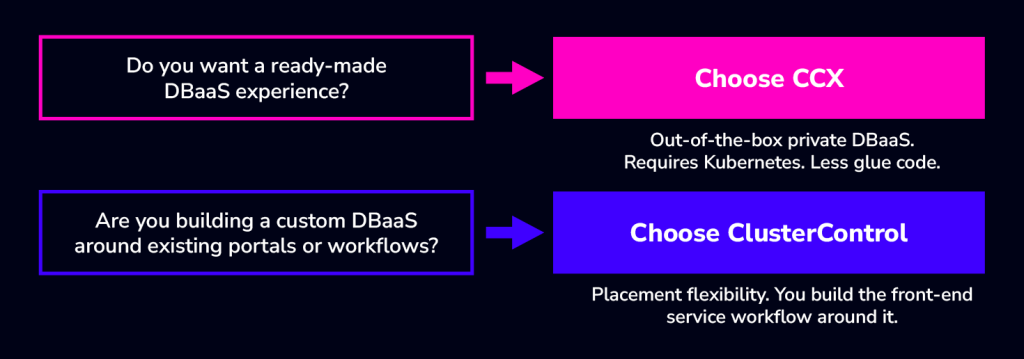
Database automation anywhere with Clustercontrol
Choose it when you have:
• Existing or app-specific database environments
• VM, Kubernetes, on-prem, cloud, or hybrid placement
• Custom portals, workflows, or an internal services foundation
Best when you want ultimate infrastructure and database flexibility.
Out-of-the-box DBaaS with CCX Sovereign
Choose it when you need:
• Ready-to-go Private DBaaS
• Kubernetes-based control plane
• Approved database service catalogue
• Standardized DB ops and admin control
Best when you want a packaged database service layer.
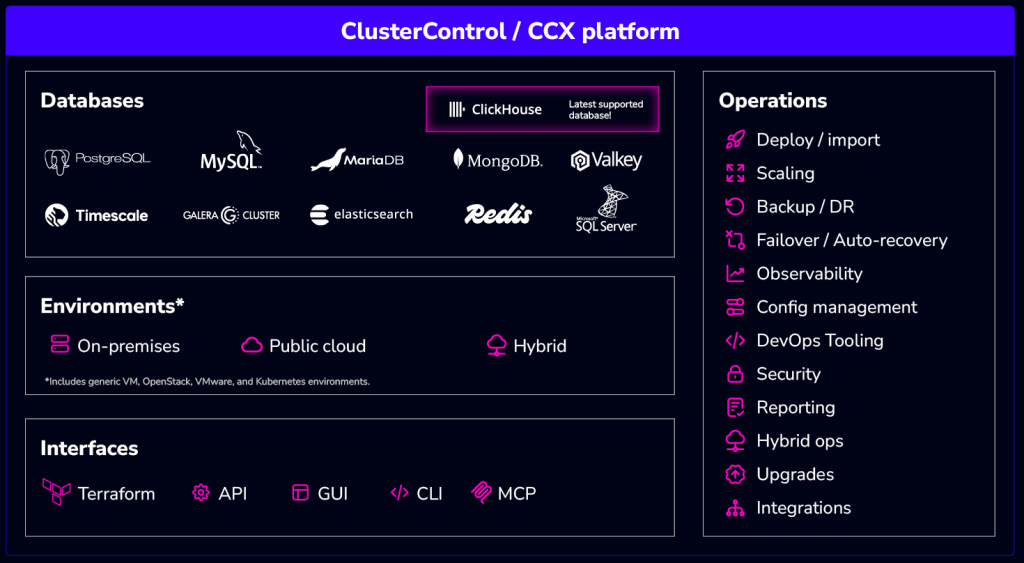
Get the databases, operations and interfaces where and how you want
Special WAD OFFER: Up to 40% off your first year
How to choose between Clustercontrol or CCX in two questions
Book your assessment to choose the best solution and take advantage of our offer
What is the difference between CCX and ClusterControl?
ClusterControl is a VM-based, self-managed hybrid database automation platform, while CCX is a K8s-based platform that allows you to deliver one to internal teams or external customers on your own infrastructure.
Where can I install ClusterControl?
Install ClusterControl on any linux distribution wherever is convenient, on-premise, air-gapped, in the private and public clouds, etc.
Where can I deploy CCX?
You can roll your own so long as your infrastructure is based on OpenStack, CloudStack, VMware, zadara, GCP, and AWS and you’re running K8s.
Do I have to create a VM for ClusterControl?
You can also install ClusterControl into a Kubernetes cluster via our Helm chart.
When I import a production database into the console what happens?
You add ssh credentials in order to connect to the server (on-prem or cloud) and add the IP and port and user/password. ClusterControl doesn’t touch any installations and just gets the replication or cluster environment under control by sending alerts and events that you can act upon accordingly.